Is there any way to change the rendering resolution of lomiri?
-
Hi, I'm trying to figure out a basic of UT device to port 20.04 to my Redmi 9 (lancelot/galahad). I posted in this thread because other xiaomi units of this generation may have had similar issues.
At the moment the interface is really slowing down, although there is hardware acceleration support. While testing, I was able to run glxgears and do a lot of other non-complex tests to conclude that the performance drop is caused by software redrawing inside Lomiri. What's interesting is that windowed mode runs many times smoother (I was even able to watch videos in the media player without stuttering). It also looks like Lomiri has broken focusing (see screenshot):
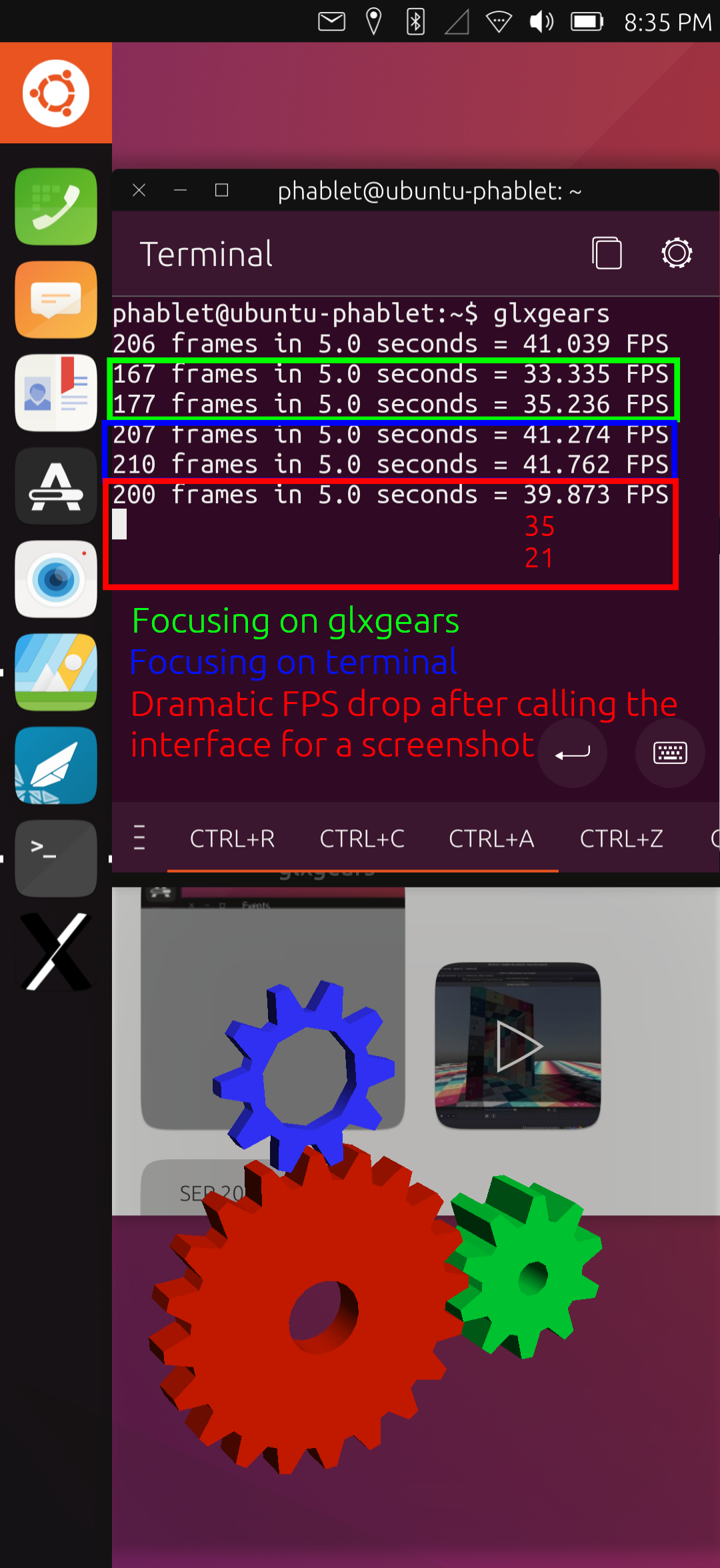
And user input causes a small performance hit, but not as bad as redraw.
Is it possible to change the rendering resolution of Lomiri to reduce CPU load and eliminate/confirm my redraw guess?
If this is not possible, can you point me to the real problem of performance degradation?
I've tried changing udev rules:
https://gitlab.com/ubports/porting/community-ports/android10/xiaomi-redmi-9/xiaomi-lancelot/-/blob/master/overlay/system/lib/udev/rules.d/70-lancelot.rules?ref_type=headsIt looks like the "graphics" group is deprecated and replaced by "android_graphics" in UT 20.04:
ACTION=="add", KERNEL=="mali", OWNER="system", GROUP="graphics", MODE="0666"
ACTION=="add", KERNEL=="ion", OWNER="system", GROUP="graphics", MODE="0666"
I also copied some lines from the volla repository (yggdrasilx) as it has a similar Mediatek SoC:
https://gitlab.com/ubports/porting/reference-device-ports/android10/volla-phone-x/volla-yggdrasilx/-/blob/focal/overlay/system/usr/lib/udev/rules.d/70-yggdrasilx.rules?ref_type=headsI also made some other minor changes to the system and it gave a more smooth interface + in glxgears FPS went up by 4 . But I can't claim that my changes led to this, since I didn't do proper testing, maybe the stability of Lomiri on my device depends on the moon phase

-
Now I checked the operation with -input flag and saw that rendering is going through llvmpipe( No hardware acceleration. Need help, I don't understand what I'm doing wrong and there is no documentation or I haven't looked hard enough.
-
@RAS there are some options regarding Mir Display Server and how the graphic pipeline is accessed.
May be you can experiment with different options, see:
https://docs.ubports.com/en/latest/porting/configure_test_fix/device_info/Mir.htmlFor the FP3 I could fix some graphic glitches with following options:
https://gitlab.com/ubports/porting/community-ports/android10/fairphone/fairphone_fp3/-/blob/halium-10.0/overlay/system/etc/deviceinfo/devices/FP3.yaml?ref_type=headsDevices: BQ e4.5, Fairphone 2, Fairphone 3, Lenovo X605F, Pinephone, Moto Z2 Force, OnePlus5T
-
@RAS also glxgears seems to be running via XMir / XWayland, which does not provide hardware acceleration, if I am not mistaken.
-
@arubislander Thanks for the tip! I had forgotten about that. Eglinfo shows Android under vendor. es2_info shows Mesa Project. Could it be a conflict between Mesa and the Android driver? Mali G-52 support is in the Mesa driver via the Panfrost module:
https://docs.mesa3d.org/drivers/panfrost.html -
@Luksus Yes, I tried changing the values in those configs, but it didn't affect anything, not even the interface scaling. When I change the values in UT Tweak Tool, it also has no effect on galahad.yaml and lancelot.yaml, but it does change the interface scaling. Device-info shows the galahad.yaml config, although my device is "lancelot" and this config exists in the system. It seems that lomiri does not use either lancelot.yaml or galahad.yaml for configuration. How can I explicitly tell the system that my device is "lancelot"?
-
@Luksus It turns out that it is not enough to reboot lomiri to apply the configuration, the whole system needs to be rebooted. Now the configuration is applied, but nothing changes except the interface size. Anyway thanks for the help, now I know a bit more about how lomiri works.
-
@RAS Yes, those yaml files you mentioned are only read on boot, as you have found out already.

Hello! It looks like you're interested in this conversation, but you don't have an account yet.
Getting fed up of having to scroll through the same posts each visit? When you register for an account, you'll always come back to exactly where you were before, and choose to be notified of new replies (either via email, or push notification). You'll also be able to save bookmarks and upvote posts to show your appreciation to other community members.
With your input, this post could be even better 💗
Register Login